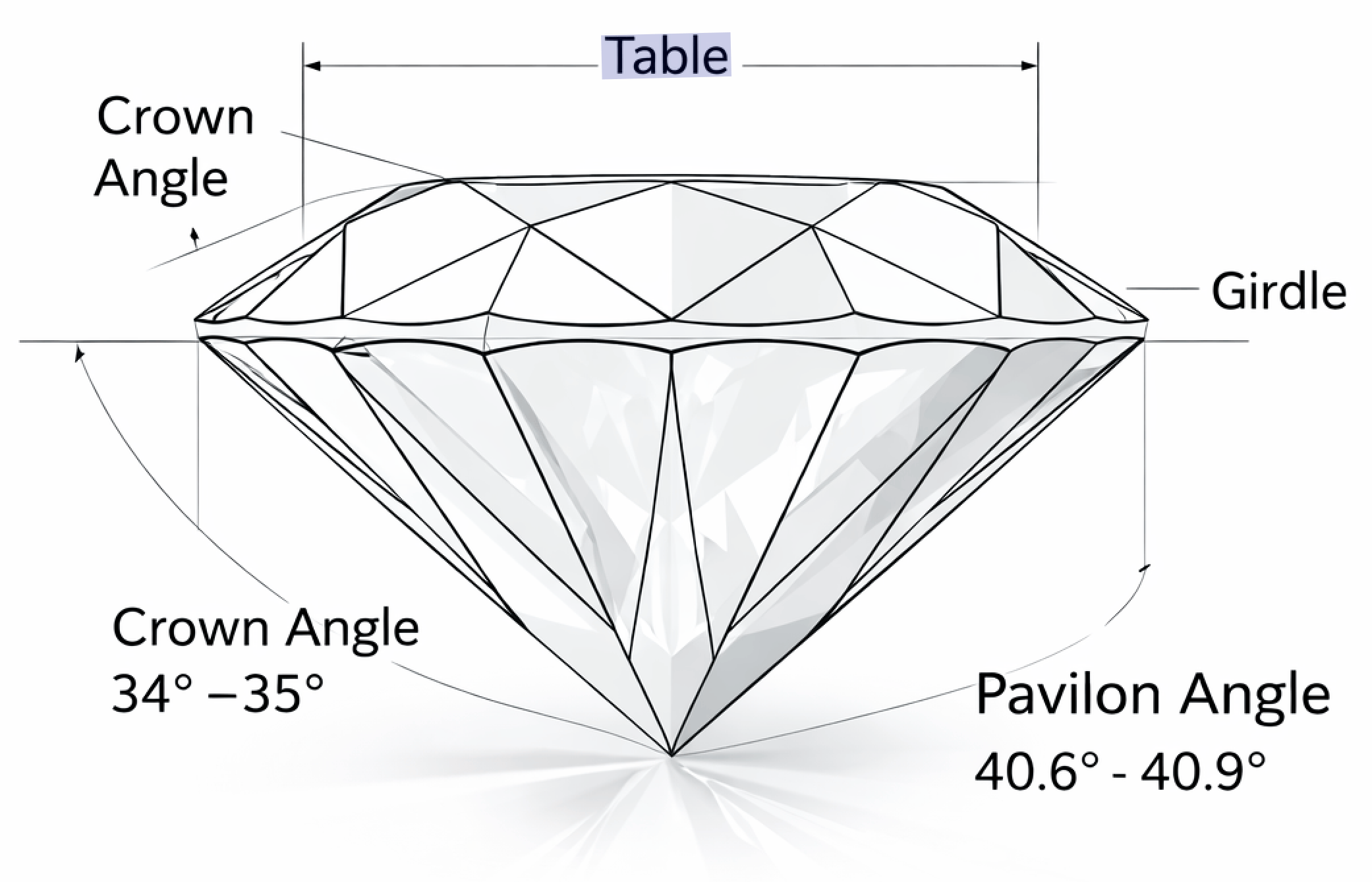
Diamond color is often discussed as a standalone characteristic, yet in practice it is closely connected to how a diamond is cut and how light moves through the stone. While color grading provides a standardized framework for comparison, the way color is perceived by the human eye depends heavily on proportions, angles and overall light performance. At the Clarkfield Diamond Cut Learning Center, we approach diamond color not as an isolated metric, but as one part of a larger system where cut quality plays a defining role in visual appearance.
What Diamond Color Really Measures
Diamond color grading measures the presence or absence of body color within a diamond, typically along a scale that ranges from colorless to visibly tinted. This assessment focuses on subtle yellow or brown tones that naturally occur during a diamond’s formation. Under controlled lighting and against neutral comparison stones, graders evaluate how much warmth is detectable when the diamond is viewed face down. The purpose of this system is consistency, allowing buyers and professionals to compare stones using a shared visual language.
What diamond color grading does not measure is how that color will appear once the stone is set, worn and viewed from the top. In real world conditions, factors such as cut precision, light return and contrast patterns can significantly influence perceived color. A well cut diamond can mask small amounts of warmth by reflecting light efficiently back to the viewer, while a poorly cut diamond may reveal color more readily due to light leakage and reduced brightness.
It is also important to understand that diamond color grading evaluates the body color of the material, not surface reflections or flashes of fire. Dispersion and sparkle can visually distract the eye, making a diamond appear whiter than its grade might suggest. This is why color should never be evaluated in isolation. At the Clarkfield Diamond Cut Learning Center, we emphasize that color is best understood in context, alongside cut quality and light performance, rather than as a standalone number on a certificate.
The Diamond Color Scale From Colorless to Light Tints
The diamond color scale is designed to measure how much natural body color is present in a white diamond. Most grading systems, including those used by major laboratories, begin at D for completely colorless stones and move downward toward Z as faint yellow or brown tints become more noticeable. This scale exists because even subtle color differences can influence how bright or white a diamond appears when viewed face up, especially under neutral lighting. The following shows how how GIA deals with diamond color and it’s quite intuitive to understand.
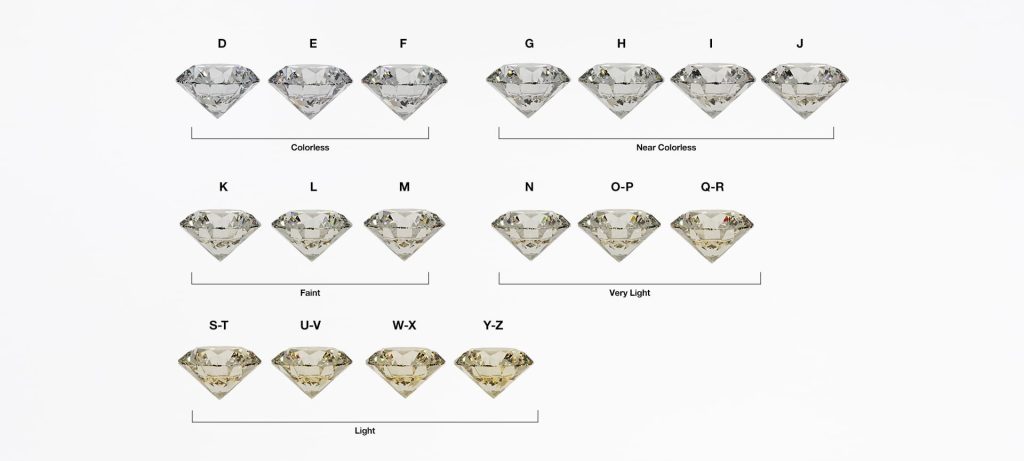
As you can see, colorless diamonds in the D to F range show virtually no body color when examined by a trained grader under controlled conditions. These stones allow light to pass through without any noticeable tint, which can enhance the perception of crispness and purity. As the scale moves into the near colorless range, typically G through J, very slight warmth begins to appear, though it is often invisible to the untrained eye once the diamond is set in a ring.
Beyond the near colorless range, diamonds graded K through M begin to show light tints that can be detected more easily, particularly from the side view. These diamonds may display a soft yellow or creamy tone, which some buyers actually find appealing depending on the setting and metal choice. At this point on the scale, color becomes a more obvious factor in overall appearance and should be evaluated carefully alongside cut quality.
Lower on the scale, from N to Z, diamonds show increasingly visible color that is no longer subtle. These light tints are clearly noticeable without magnification and can influence how light interacts within the stone. While such diamonds can still offer value in certain contexts, especially for larger sizes or vintage styles, understanding where a diamond sits on the color scale helps buyers make informed decisions about appearance, balance, and visual priorities.
How Diamond Cut Influences Perceived Color
Diamond cut plays a surprisingly large role in how much color the human eye perceives in a diamond. Even when two stones share the same laboratory color grade, differences in cut quality can make one appear noticeably whiter or warmer than the other. This happens because cut controls how light enters the diamond, how long it remains inside, and how efficiently it returns to the eye. Strong light return tends to mask body color, while light leakage exposes it.
Well cut diamonds with balanced crown and pavilion angles bounce light back toward the viewer at optimal angles. This creates higher brightness and contrast, which visually dilutes faint yellow or brown undertones. In contrast, diamonds with shallow or overly deep proportions often leak light through the pavilion or sides, allowing body color to become more visible. This is why a poorly cut G color diamond can look warmer than a well cut H or even I color stone.
Cut also affects perceived color through patterning and contrast. Crisp facet contrast creates visual distraction, drawing attention to sparkle rather than tint. Shapes and cutting styles matter as well, since step cuts like emerald cuts tend to reveal color more easily than brilliant cuts due to their open facet structure. Understanding this interaction helps explain why cut quality is often the most effective way to improve a diamond’s visual appearance without moving up the color scale.
Color Versus Cut: Which Matters More Visually
When comparing color versus cut, cut almost always has the greater impact on a diamond’s visual appearance. A diamond with excellent proportions and strong light performance will look brighter, livelier and more attractive than a higher color stone with mediocre cut quality. Because brilliance and contrast dominate what the eye notices first, cut tends to override small differences in body color, especially in the near colorless range.
Color differences become subtle very quickly once a diamond reaches grades like G or H, particularly when viewed face up. At that point, improvements in cut quality provide far more visible benefits than moving up one or two color grades. A well cut H color diamond can easily appear whiter than a poorly cut F color diamond, simply because efficient light return masks faint warmth while enhancing sparkle.
That said, cut and color should be balanced rather than treated in isolation. Extremely poor color cannot be fully hidden by cut, and extremely poor cut will undermine even the best color grades. Visually, however, prioritizing cut quality first delivers the most noticeable improvement per dollar spent, making it the dominant factor for most buyers focused on beauty rather than laboratory labels.
Common Misunderstandings About Diamond Color
One of the most persistent misunderstandings about diamond color is that it refers to how white a diamond looks in everyday wear. As IGI’s post on diamond color explains, diamond color grading actually measures the absence of color, not the presence of it. The grading scale evaluates how much yellow or brown tint exists when a diamond is viewed under controlled conditions, which is very different from how it appears once mounted and viewed face up.
Another common misconception is that higher color grades always produce a visible improvement. While diamonds graded D through F are technically colorless, the visual difference between these grades and near colorless diamonds such as G or H is minimal for most observers. IGI emphasizes that these distinctions are often detectable only by trained gemologists using master stones and standardized lighting, not by the naked eye in real world settings.
Many buyers also assume that color grading reflects how a diamond is judged in normal orientation. In reality, diamonds are graded upside down to make color more visible through the pavilion. This method exaggerates tint compared to how the diamond is worn, which can lead buyers to overestimate the importance of achieving the highest possible color grade rather than focusing on overall visual performance.
Another misunderstanding is the belief that color exists independently of other factors. Cut quality plays a major role in how color is perceived. Well cut diamonds reflect and disperse light more efficiently, often appearing brighter and whiter than their color grade alone would suggest. This aligns with IGI’s guidance to balance color decisions with cut rather than isolating color as a standalone priority.
Finally, many shoppers believe that color should be prioritized over all other characteristics because of its impact on price. While color does influence value, it is rarely the strongest driver of beauty. IGI consistently notes that understanding how color interacts with cut, setting metal, and diamond size leads to smarter decisions. When these elements are considered together, buyers often find they can choose a lower color grade without sacrificing visual appeal.
Bringing Diamond Color and Cut Knowledge Together
Understanding diamond color and cut together allows buyers to move beyond individual grades and focus on how a diamond truly performs in real life. Color grades describe the absence of tint, while cut determines how effectively light is returned to the eye. When these two factors are considered as a pair rather than in isolation, it becomes much easier to predict how bright, lively and visually pleasing a diamond will appear once set and worn.
In practice, a well cut diamond can often compensate for a slightly lower color grade by reflecting light more efficiently and reducing the visibility of warmth. This is why experienced gemologists place so much emphasis on proportions, symmetry and angle relationships. By learning how cut quality influences both brilliance and perceived color, buyers gain the confidence to make informed trade offs that align with their budget and aesthetic preferences.
For readers looking to deepen their understanding further, our in depth discussion on diamond color explores how grading works and how color behaves in different lighting and settings. When this knowledge is combined with a solid grasp of cut fundamentals, evaluating diamonds becomes less about chasing the highest grades and more about recognizing balance, craftsmanship and visual performance as a whole.